

Get Fact First - April 1, 2025
Vol 1, 12.

Transnational Repression
In their weekly update yesterday, national security officials flagged a growing concern ahead of the federal election: transnational repression.
It’s a tactic foreign governments use to intimidate or silence people — activists, students, journalists, and politicians. The goal is simple: suppress dissent, pressure people to vote a certain way, and ultimately undermine democracy.
One case continues to draw attention, though it wasn’t named directly at yesterday’s press conference: Liberal MP Paul Chiang.
In a January interview with Chinese-language media, Chiang suggested his Conservative opponent, Joe Tay, should be handed over to the Chinese Consulate in Toronto. This came after Hong Kong police placed a HK$1-million bounty — about $184,000 — on Tay for allegedly violating China’s National Security Law.
Tay has been an outspoken critic of Beijing’s crackdown on civil liberties in Hong Kong.
Promoting a foreign bounty on a Canadian politician is considered a form of coercion — part of a broader threat that extends online, including fake social media campaigns and deepfake attacks aimed at smearing MPs.
As of last night, Chiang confirmed he will not run in the next federal election.
Canadian officials are promising to reach out to targeted individuals, report malicious content, and confront the foreign governments involved.
But with the speed of online sharing, is that even possible? Canadian authorities face bureaucratic barriers and often respond with delays — sometimes days or weeks — if the threats are detected at all.
GOP Pushes Back on Canada Tariffs
Some Republican Senators to Vote Against Tariffs on Canada.
It’s a wait-and-see moment as the Trump administration prepares to impose 25% across-the-board tariffs on imports from Canada tomorrow — with Canadian energy facing a lower 10% rate. However, a group of Republican senators may try to block the move.
Senator Susan Collins of Maine, calling the plan a “huge mistake,” warns it would damage key industries in her state. She’s joining others — from Amy Klobuchar (D-Minn.) to Rand Paul (R-Ky.).
Democratic Senator Tim Kaine is leading the resolution to revoke the emergency powers Trump is using to justify the tariffs under the International Emergency Economic Powers Act. In a Washington Post op-ed - Why I’m Forcing a Vote on Trump’s Canada Tariffs - Kaine calls the move an overreach.
Kaine’s resolution has Democratic support and needs four Republican votes to pass. Some GOP senators appear open. Still, even if it clears the Senate, Speaker Mike Johnson has blocked similar efforts in the House, making a final vote unlikely.
The pushback highlights growing cracks in the GOP, especially along border states. Not every Republican is willing to punish Canada — especially when their own states stand to lose.
Spotting Disinformation: The Illusory Truth Effect
One way to spot disinformation and influence campaigns online is to question the words you hear again and again.
This is called the illusory truth effect — the more something is repeated, the more believable it starts to sound, even if it’s false.
Coordinated messaging — often pushed by influencers — relies on this.
Take repatriation. In the context of the auto industry, the word is misleading.
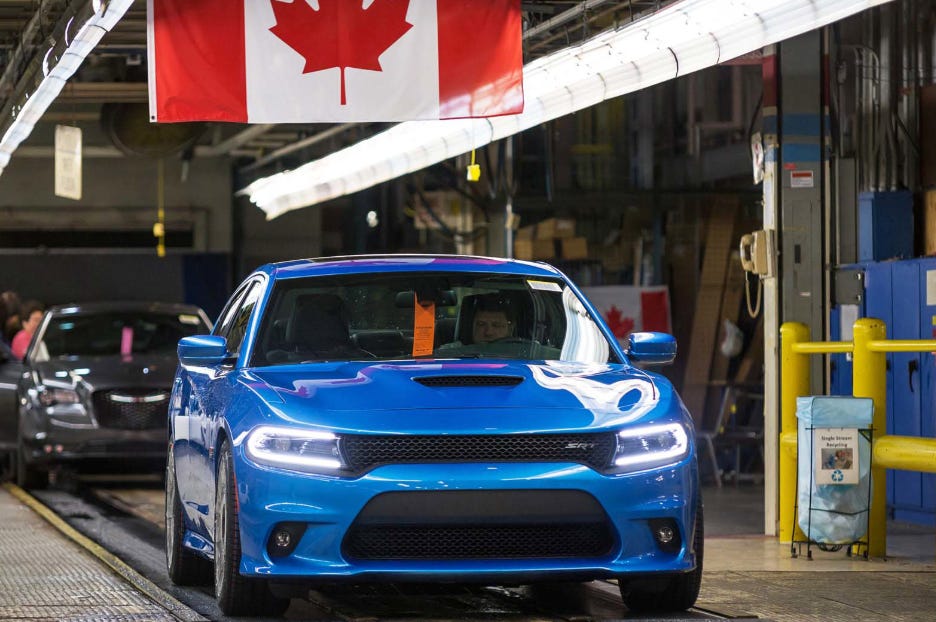
The Trump administration talks about “repatriating” the auto sector — as if it were stolen and needs to be brought back home. The word spreads fast, from White House briefings to press releases to headlines, repeated until it starts to feel like fact.
But Canada didn’t take the auto industry from the U.S. It’s been here for over a century — expanded after WWII and tightly integrated with the U.S. through the 1965 Auto Pact.
Canada helped shape both NAFTA and the USMCA.
Today, auto manufacturing runs on cross-border supply chains. It’s not an American system or a Canadian one — it’s North American.
“Repatriating” it would take decades, cost tens of billions, and require a complete overhaul.
Example of Fake News Deepened Divides
A new paper on Indonesia’s 2024 election shows how fake news flooded platforms like Facebook, TikTok, and WhatsApp — and how that misinformation deepened political divides.
Researchers found that in places like Jember, repeated exposure to false claims reinforced existing beliefs, eroded trust in credible news sources, and widened the gap between political groups.
Despite regulations meant to fight misinformation, enforcement was weak and inconsistent.
Canada Still Failing to Confront Foreign Interference
The Montreal Institute for Global Security released a new report on foreign interference and disinformation.
The report aims to help Canadians better understand these threats and builds on findings from Justice Hogue’s public inquiry, which concluded the federal government has failed to effectively protect Canadians — especially diaspora communities — from foreign influence.
The core message: current government efforts still fall short, particularly in enforcement, community outreach, and countering state-linked harassment, especially from China. Key recommendations from the Hogue inquiry — including tighter oversight of political nominations — remain largely unimplemented.
“This is a really important moment in our country’s history,” Bridgman said, “where we need to make sure we have a national conversation and we are confident that whoever wins the election is the real winner and that the election is free and fair.”
Aengus Bridgman, McGill professor and director of the Media Ecosystem Observatory.
More Evidence Canada Is Slow to Act on Foreign Interference
Disinformation is widely seen as a top threat to Western democracies. The Trump administration, however, often frames any efforts to stop as censorship.
A new report — AI, Innovation and the Public Good: A New Policy Playbook — from the Waterloo-based Centre for International Governance Innovation (CIGI), examines how Canada is falling short in responding to foreign interference, even as digital vulnerabilities grow. This is especially critical as our country’s media relies heavily on U.S. platforms.
CIGI, founded by Jim Balsillie, is funded through his endowment and support from various levels of government.

The report notes that Canada’s fragmented media landscape — especially within diaspora communities — has become a growing target for authoritarian regimes like China and Russia.
The report LINK
Let us know if you see anything worth sharing—Canadians pushing back against attacks, misinformation, or disinformation.
And if we got something wrong? Tell us. It happens. We correct it.
See you Tomorrow
While interference seems to be stemming from US based platforms, why can't we ban these platforms due to their non-compliance of fact checking? Why can't we have a Canadian type fb, IG and so on so that we can control such misinformation. It's one thing to have an opinion, but it's another when things are presented in a twisted way and are full out lies. This is what we are facing now. And it seems that a lot of people fall for all these slogans and the repeated false narratives.